Legal Update: Lawsuit Filed over Broadway Upzoning

Note to ASCO Members: ASCO is sharing this report to keep our members informed of local developments. This post serves as a summary of publicly available information regarding the lawsuit filed by ERRD and does not constitute a formal endorsement of the litigation.
On January 12, 2026, the Edgewater Residents for Responsible Development (ERRD), along with 13 local residents and business owners, filed a lawsuit in Cook County Circuit Court.
The legal challenge centers on the City of Chicago’s October 16 decision to upzone approximately 1.5 miles of the Broadway neighborhood shopping district—a move the plaintiffs describe as “unprecedented” in scope and scale.
Primary Legal Allegations
-
Violation of Due Process
The complaint alleges that the city enacted sweeping rezoning without the legally required public study, notice, and planning process.
-
Neighborhood Impact
Plaintiffs argue the upzoning encourages demolition of historic buildings and alters the long-standing fabric of the shopping district.
-
Request for Invalidation
The suit asks the court to invalidate the upzoning and restore the properties to their prior zoning classifications.
“Edgewater’s Broadway is a vital district with historic buildings housing beloved small businesses. The City’s upzoning targets these for demolition. We were left with no other recourse.”
— Patricia Sharkey, ERRD President
Related Documents
Matching Gift Challenge
Recognizing the costs of litigation, several Broadway small businesses have offered a $15,000 Matching Gift Challenge to support ERRD’s legal efforts through the end of January.
ERRD@baliozian.com
@ERRD1
ERRD, 6236 N. Lakewood, Chicago, IL 60660
Information provided by ERRD. Not an ASCO managed fund.
The Win-Win Roadmap
ERRD has proposed an alternative set of planning principles for responsible development on Broadway, currently supported by over 650 residents.
Alderwoman Manaa-Hoppenworth has asked ASCO to publish the letter below to provide more information regarding ongoing work and plans in the 48th Ward
A Message from Alderwoman Manaa-Hoppenworth:
Dear Neighbors,
Sheridan Road is one of the densely populated streets in Chicago, and home to a number of vulnerable populations including older adults. Pedestrian safety on Sheridan Road is a top priority of our office, and we are collaborating with neighbors, community leaders, and CDOT on a number of initiatives to slow down cars, create pedestrian-friendly infrastructure, and organize our streets to improve safety for all users. We appreciate ASCO’s collaboration on all of these efforts, and hope that you are seeing the impact of the improvements!
New Speed Camera
In Spring 2025, we added a speed camera to Sheridan Road between Glenlake and Granville. After a 30 day warning period, 1,252 tickets were issued within the first 15 days. The location of the speed camera was determined in collaboration with CDOT and the community, and tickets speeders going both north and south-bound. Eight new Speed Limit signs that have been installed near the speed camera. This camera was formally requested by ASCO in January 2025 and installed after a CDOT evaluation.

Decorative Cross-Walks
In 2024, the 48th Ward voted to add decorative cross-walks to five intersections on Sheridan Road. These cross-walks encourage drivers to slow down and reduce the number of vehicles blocking the cross-walks. They give the street a pedestrian-friendly look and feel. This $240,000 project was on the ballot during the first ever 48th ward participatory budgeting vote, and was the most popular project on the ballot. The decorative cross-walks have been installed at the locations listed below.
- Sheridan & Rosemont
- Sheridan & Granville
- Sheridan & Glenlake
- Sheridan & Thorndale
- Sheridan & Ardmore
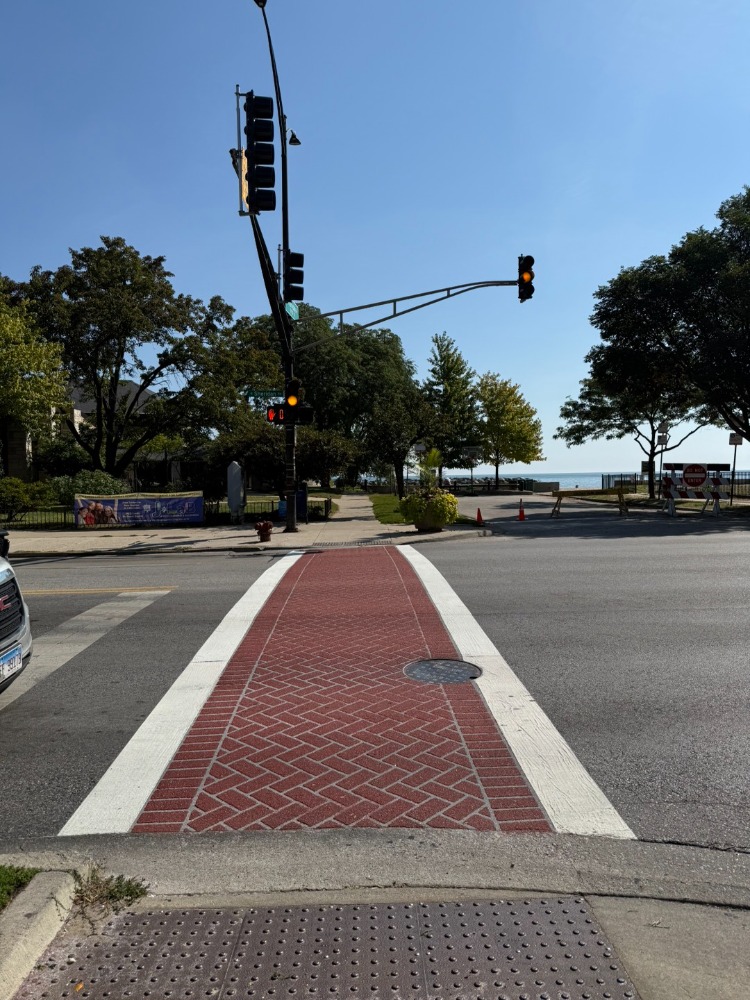
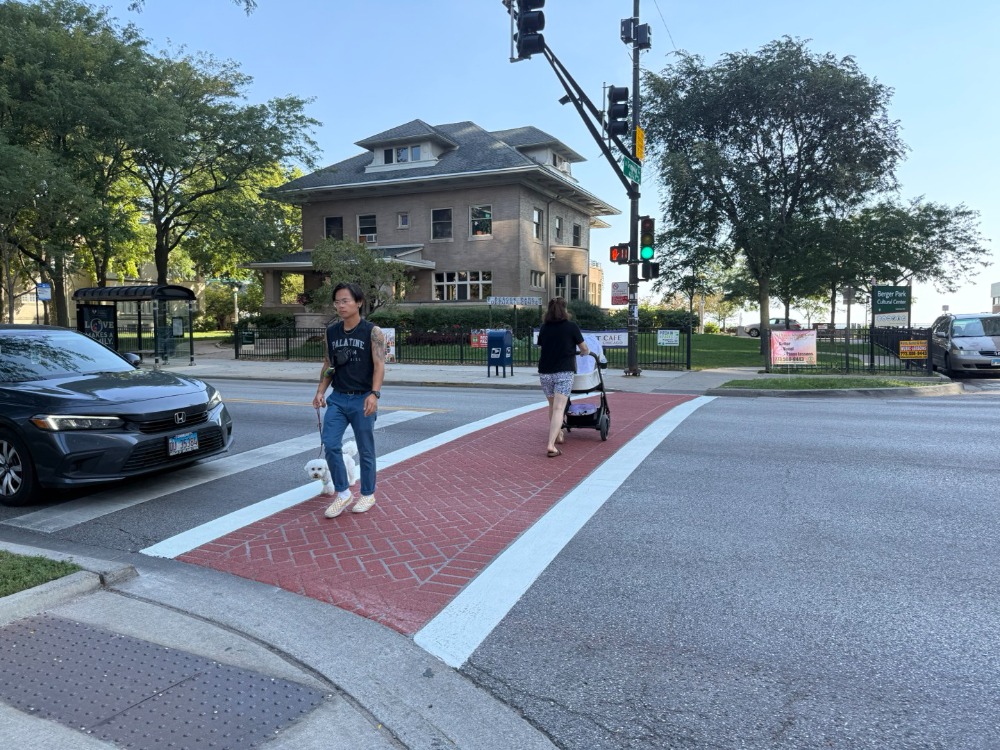
Decorative cross-walks on Bryn Mawr including Sheridan & Bryn Mawr were voted on in 2025, and will be coming soon.
Increased Walk Time at Sheridan & Glenlake
At the request of residents, we worked with CDOT to review and design a new timing plan at Sheridan & Glenlake. This resulted in increasing the “walk” time for crossing Sheridan by 3 seconds (12 to 15 seconds). This was done by shifting 3 seconds of green time from Sheridan to Glenlake.
Audible Cross-Walk at Sheridan & Balmoral
In 2025, the community voted to add an Audible Cross-Walk at Sheridan & Balmoral through the Participatory Budget process. The total cost of the improvement is $180,000. The audible cross-walk is expected to be installed in 2026.
Traffic Light at Sheridan & Balmoral
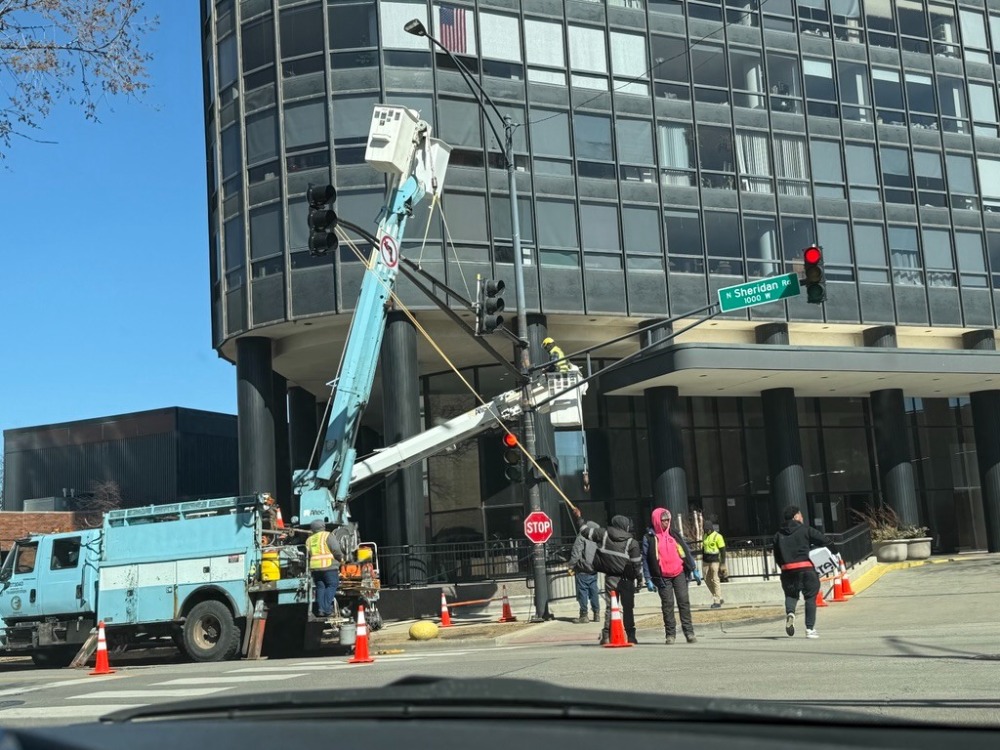
In March 2025, we replaced the missing traffic light that hangs over the street at Sheridan and Balmoral.
Improvements at Catalpa & Sheridan
We worked with CDOT and community members on a traffic study at Catalpa and Sheridan which resulted in the following:
- “Stop Ahead” Pavement Markings in the approach to Catalpa for north and southbound traffic
- Decorative cross-walks
- New “Stop Ahead” signage for northbound traffic
- Re-positioning of the “Stop Ahead” sign for southbound traffic to enhance visibility
The new signage and re-positioned signage was implemented in 2025, and the pavement markings will be implemented in 2026. We are coordinating the timing of the pavement markings with DWM and CDOT based on other projects on the block.
Thank you to all of our Sheridan Road neighbors for your partnership on these pedestrian safety improvements. Read about these projects as well as upcoming 2026 projects on our blog: Pedestrian Safety Improvements on Sheridan Road.
In Community,
Alderwoman Leni Manaa-Hoppenworth
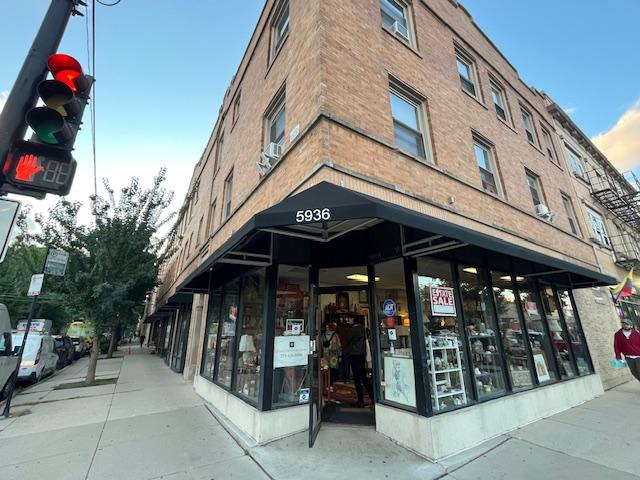
The Greenest, Most Affordable Housing
Is the Housing We Already Have
By Jack Markowski
As Chicago debates the future of Broadway in Edgewater, one simple truth is being overlooked: the greenest housing is the housing we already have. Every time we demolish an existing building and replace it with new construction, we incur an enormous carbon cost. The embodied energy in brick,wood, and concrete — all the materials that went into our older buildings — is lost, and the emissions from producing and transporting new materials are added to the atmosphere. Preservation isn’t nostalgia; it’s climate policy.
But environmental impact is only half the story. Existing housing is also our city’s most affordable housing; it’s called Naturally Occurring Affordable Housing. The one to three-story buildings that line Broadway provide naturally affordable homes for working families, seniors, and young people; they also house a vast array of locally owned businesses. When those buildings are replaced by upscale new developments, the result isn’t a wider range of choices — it’s higher rents and fewer options for current residents and businesses…
Supporters of upzoning claim that allowing taller, denser private developments will eventually lower rents on Broadway and throughout Edgewater. That theory — a “trickle down” approach to housing — depends on an unrealistic assumption: that private developers will build so much market-rate housing that supply vastly outstrips demand. In fact, in Chicago this has never proven to be true. There is not a single instance where development has led to price reductions in a local housing market. In Edgewater, a thriving and desirable community, this will never happen. Prices won’t drop until the neighborhood loses the very qualities that make people want to live here…
Preserving existing housing and protecting local businesses isn’t just about saving old buildings. It’s about protecting affordability, reducing emissions, and keeping neighborhoods like Edgewater strong.
Jack Markowski is the former Commissioner of the Chicago Department of Housing and former President /CEO of the Community Investment Corporation, the Chicago area’s leading lender for affordable rental housing.
